
Philippines staffing research
Do Reviewers Agree on Payment-Posting Exceptions?
An inter-rater protocol tests remittance matching, partial payments, reversals, duplicates, and unresolved balances.
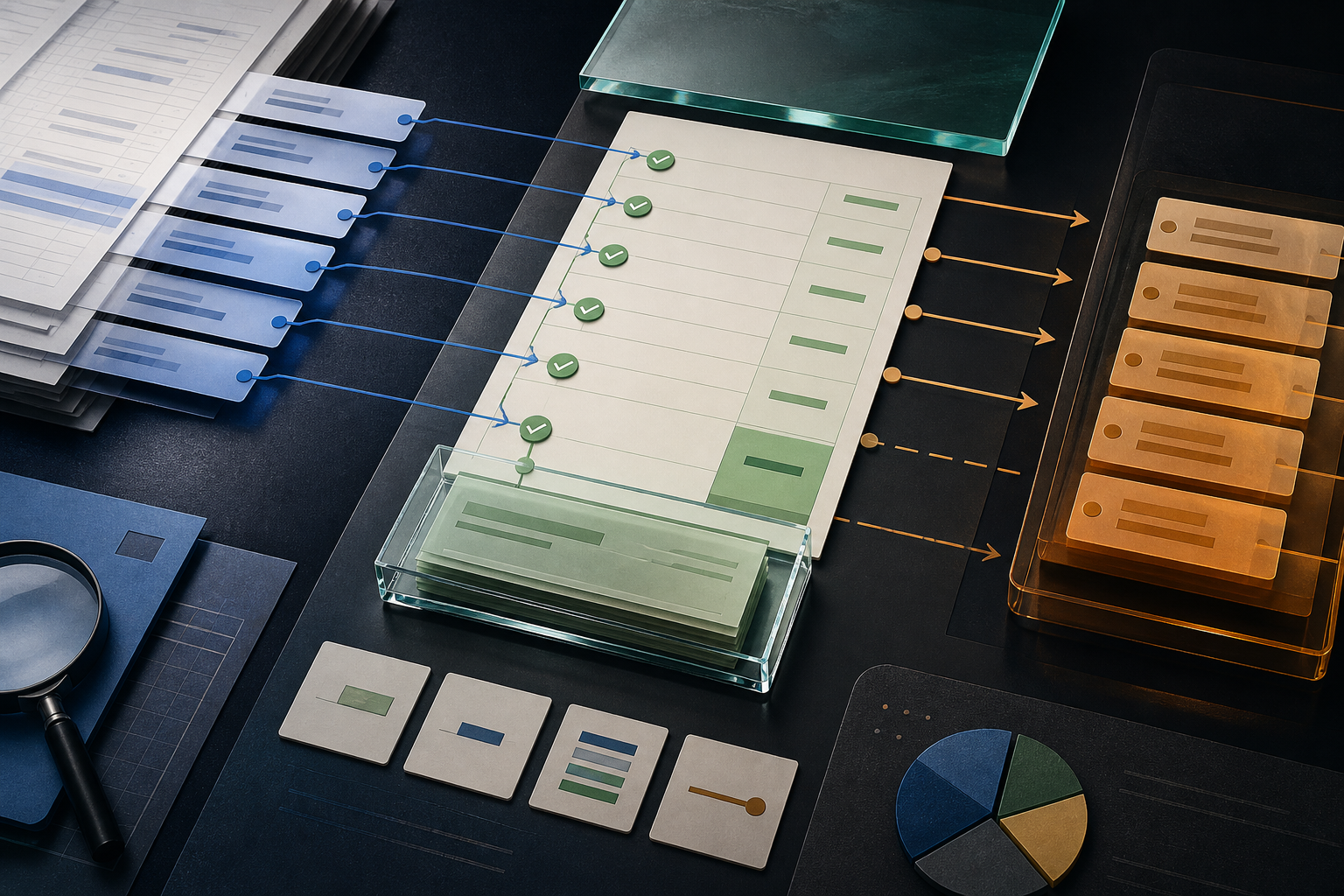
Research question. Do Reviewers Agree on Payment-Posting Exceptions? An inter-rater protocol tests remittance matching, partial payments, reversals, duplicates, and unresolved balances. The unit is one bounded billing case linked to its sources, preparation, owner decision, transaction event, communication, and later verification. The protocol reports no provider performance and transfers no client authority.
Declare population, inclusion and exclusion rules, observation window, systems, roles, time zones, and unavailable evidence before viewing outcomes. For study stage 1, retain the first-pass classification, cited artifact, reviewer confidence, unresolved question, accountable owner, and downstream consequence so another authorized reviewer can reproduce the result.
Calibration stage 1 includes a normal record, a deliberately ambiguous record, a missing artifact, and a consequential exception. Delay one acknowledgement and introduce a plausible conflict. Observe whether reviewers preserve uncertainty, remain within access boundaries, and route the exact decision instead of repairing the record by assumption.
Publish the expected artifact, reviewer role, acceptable evidence, exclusion rule, response clock, and closure condition before sampling. Compare timestamps in a declared timezone and leave unavailable evidence visible. Where reviewers disagree, report each initial classification before consensus; never replace the original result with only a clean final answer.
Separate source fact, coordinator preparation, owner decision, executed event, communication, and verified outcome into distinct evidence fields. For study stage 2, retain the first-pass classification, cited artifact, reviewer confidence, unresolved question, accountable owner, and downstream consequence so another authorized reviewer can reproduce the result.
Calibration stage 2 includes a normal record, a deliberately ambiguous record, a missing artifact, and a consequential exception. Delay one acknowledgement and introduce a plausible conflict. Observe whether reviewers preserve uncertainty, remain within access boundaries, and route the exact decision instead of repairing the record by assumption.
Publish the expected artifact, reviewer role, acceptable evidence, exclusion rule, response clock, and closure condition before sampling. Compare timestamps in a declared timezone and leave unavailable evidence visible. Where reviewers disagree, report each initial classification before consensus; never replace the original result with only a clean final answer.
Use named accounts, least privilege, controlled exports, purpose-limited retention, and synthetic calibration before any operational sample. For study stage 3, retain the first-pass classification, cited artifact, reviewer confidence, unresolved question, accountable owner, and downstream consequence so another authorized reviewer can reproduce the result.
Calibration stage 3 includes a normal record, a deliberately ambiguous record, a missing artifact, and a consequential exception. Delay one acknowledgement and introduce a plausible conflict. Observe whether reviewers preserve uncertainty, remain within access boundaries, and route the exact decision instead of repairing the record by assumption.
Publish the expected artifact, reviewer role, acceptable evidence, exclusion rule, response clock, and closure condition before sampling. Compare timestamps in a declared timezone and leave unavailable evidence visible. Where reviewers disagree, report each initial classification before consensus; never replace the original result with only a clean final answer.
Include every predefined high-risk case and a random sample of ordinary cases, preserving substitutions and inaccessible records. For study stage 4, retain the first-pass classification, cited artifact, reviewer confidence, unresolved question, accountable owner, and downstream consequence so another authorized reviewer can reproduce the result.
Calibration stage 4 includes a normal record, a deliberately ambiguous record, a missing artifact, and a consequential exception. Delay one acknowledgement and introduce a plausible conflict. Observe whether reviewers preserve uncertainty, remain within access boundaries, and route the exact decision instead of repairing the record by assumption.
Publish the expected artifact, reviewer role, acceptable evidence, exclusion rule, response clock, and closure condition before sampling. Compare timestamps in a declared timezone and leave unavailable evidence visible. Where reviewers disagree, report each initial classification before consensus; never replace the original result with only a clean final answer.
Require independent reviewer classifications before discussion and preserve disagreement by category, evidence, and consequence. For study stage 5, retain the first-pass classification, cited artifact, reviewer confidence, unresolved question, accountable owner, and downstream consequence so another authorized reviewer can reproduce the result.
Calibration stage 5 includes a normal record, a deliberately ambiguous record, a missing artifact, and a consequential exception. Delay one acknowledgement and introduce a plausible conflict. Observe whether reviewers preserve uncertainty, remain within access boundaries, and route the exact decision instead of repairing the record by assumption.
Publish the expected artifact, reviewer role, acceptable evidence, exclusion rule, response clock, and closure condition before sampling. Compare timestamps in a declared timezone and leave unavailable evidence visible. Where reviewers disagree, report each initial classification before consensus; never replace the original result with only a clean final answer.
Report counts, denominators, medians, ranges, age bands, corrections, reversals, and unresolved cases rather than activity volume alone. For study stage 6, retain the first-pass classification, cited artifact, reviewer confidence, unresolved question, accountable owner, and downstream consequence so another authorized reviewer can reproduce the result.
Calibration stage 6 includes a normal record, a deliberately ambiguous record, a missing artifact, and a consequential exception. Delay one acknowledgement and introduce a plausible conflict. Observe whether reviewers preserve uncertainty, remain within access boundaries, and route the exact decision instead of repairing the record by assumption.
Publish the expected artifact, reviewer role, acceptable evidence, exclusion rule, response clock, and closure condition before sampling. Compare timestamps in a declared timezone and leave unavailable evidence visible. Where reviewers disagree, report each initial classification before consensus; never replace the original result with only a clean final answer.
Test sensitivity to cutoffs, risk bands, missing-evidence treatments, and policy assumptions, stating which conclusions change. For study stage 7, retain the first-pass classification, cited artifact, reviewer confidence, unresolved question, accountable owner, and downstream consequence so another authorized reviewer can reproduce the result.
Calibration stage 7 includes a normal record, a deliberately ambiguous record, a missing artifact, and a consequential exception. Delay one acknowledgement and introduce a plausible conflict. Observe whether reviewers preserve uncertainty, remain within access boundaries, and route the exact decision instead of repairing the record by assumption.
Publish the expected artifact, reviewer role, acceptable evidence, exclusion rule, response clock, and closure condition before sampling. Compare timestamps in a declared timezone and leave unavailable evidence visible. Where reviewers disagree, report each initial classification before consensus; never replace the original result with only a clean final answer.
Track correction with condition, evidence, owner, due date, implementation reference, verification, and residual limitation. For study stage 8, retain the first-pass classification, cited artifact, reviewer confidence, unresolved question, accountable owner, and downstream consequence so another authorized reviewer can reproduce the result.
Calibration stage 8 includes a normal record, a deliberately ambiguous record, a missing artifact, and a consequential exception. Delay one acknowledgement and introduce a plausible conflict. Observe whether reviewers preserve uncertainty, remain within access boundaries, and route the exact decision instead of repairing the record by assumption.
Publish the expected artifact, reviewer role, acceptable evidence, exclusion rule, response clock, and closure condition before sampling. Compare timestamps in a declared timezone and leave unavailable evidence visible. Where reviewers disagree, report each initial classification before consensus; never replace the original result with only a clean final answer.
State limitations prominently: incomplete records, system lag, reviewer judgment, policy variation, and unobserved work constrain inference. For study stage 9, retain the first-pass classification, cited artifact, reviewer confidence, unresolved question, accountable owner, and downstream consequence so another authorized reviewer can reproduce the result.
Calibration stage 9 includes a normal record, a deliberately ambiguous record, a missing artifact, and a consequential exception. Delay one acknowledgement and introduce a plausible conflict. Observe whether reviewers preserve uncertainty, remain within access boundaries, and route the exact decision instead of repairing the record by assumption.
Publish the expected artifact, reviewer role, acceptable evidence, exclusion rule, response clock, and closure condition before sampling. Compare timestamps in a declared timezone and leave unavailable evidence visible. Where reviewers disagree, report each initial classification before consensus; never replace the original result with only a clean final answer.
Sources checked October 8, 2026: GAO Green Book | https://www.gao.gov/greenbook || NIST Cybersecurity Framework 2.0 | https://doi.org/10.6028/NIST.CSWP.29 || FTC Protecting Personal Information | https://www.ftc.gov/business-guidance/resources/protecting-personal-information-guide-business-0 || CMS Medicare Claims Processing Manual | https://www.cms.gov/regulations-and-guidance/guidance/manuals/internet-only-manuals-ioms-items/cms018912.