
Philippines staffing research
Billing Downtime Recovery Research: Which Intake Records Survive the Handoff?
A September 9 evidence study asking: How completely can billing items recorded during downtime be traced into the restored production workflow?
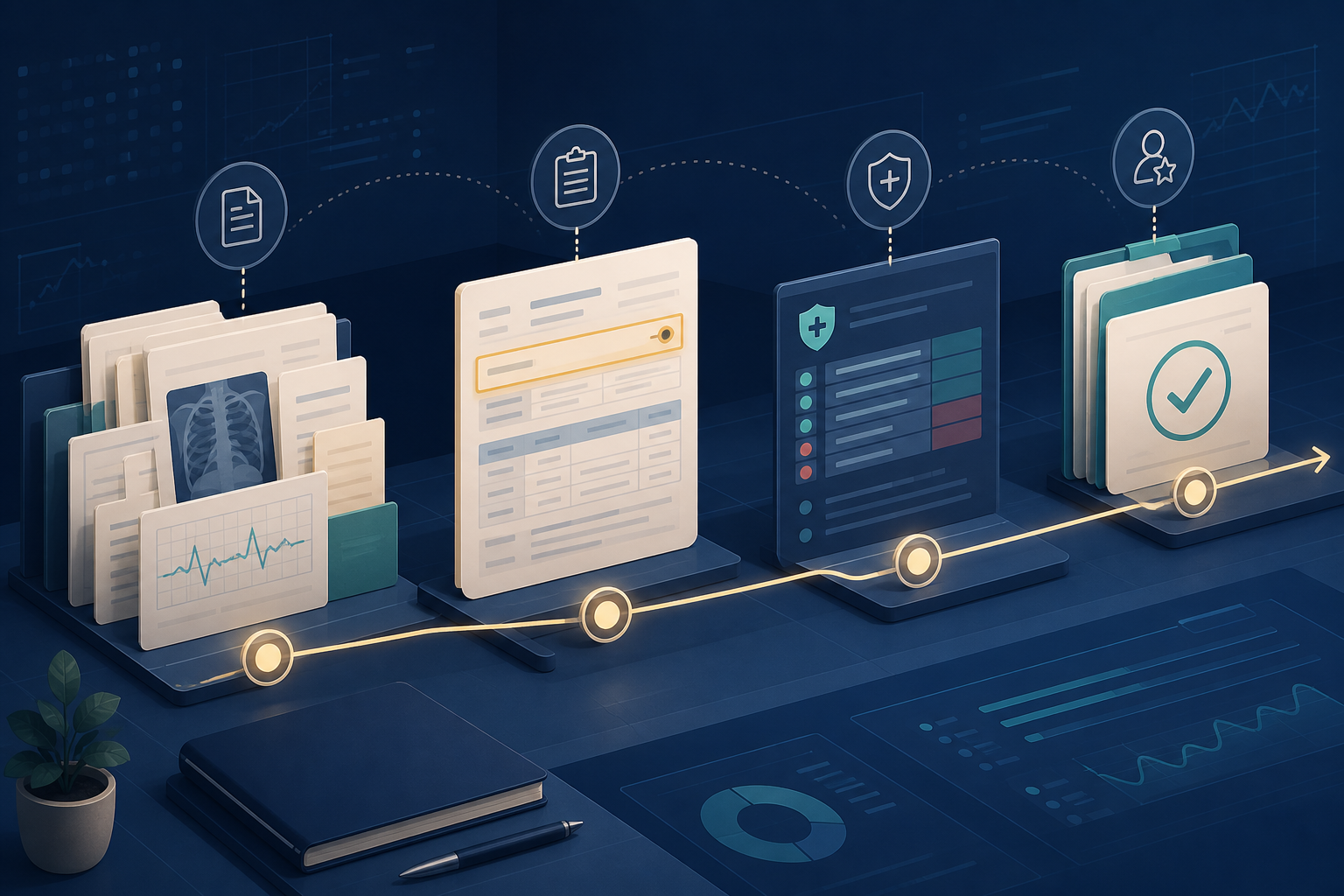
Research question: How completely can billing items recorded during downtime be traced into the restored production workflow?
Scope: This September 9, 2026 study concerns administrative evidence available to an outsourced medical billing operation. The unit of analysis is one downtime intake item with a stable approved locator. It does not evaluate clinical care, individual staff merit, legal compliance, contract entitlement, or the correctness of a payer's final decision.
Methodology: Freeze the population, observation window, source report, filters, cutoff, timezone, duplicate rule, and exclusions before reviewing results. Freeze the outage window and compare downtime logs, source documents, interface events, production entries, duplicate checks, exception states, and owner sign-off. Retain routine cases, exceptions, reopened work, missing evidence, and access failures in the reported denominator.
Measurement plan: Study 2 reports raw numerators and denominators with every rate. Event time, receipt time, system-entry time, retrieval time, and review time remain separate. Each statement is labeled observed, externally reported, calculated, owner-interpreted, or unknown.
Reliability check: Give a mixed sample to a second authorized reviewer who cannot see the first classification. Compare cohort membership, source selection, identifiers, dates, calculations, exclusions, and category. Preserve disagreements and document whether resolution required a clarified rule or owner judgment.
Analysis: Report source-confirmed, conflicting, missing, access-blocked, superseded, interpretation-required, and unresolved results. Keep sequence distinct from cause. A later event can complete a chronology without proving why an earlier event occurred.
Role boundary: Support staff may retrieve approved evidence, preserve source wording, compare fields, reproduce arithmetic, and prepare a neutral exception. Qualified owners retain coding, coverage, medical-necessity, credentialing, contract, privacy, accounting, submission, refund, write-off, and patient-communication decisions.
Inference limits: Findings describe only the frozen cohort, systems, definitions, and observation window reported here. They should not be generalized to another payer, team, or period without replication. Association, order, and missing records do not establish causation or responsibility.
Limitations: Informal notes may be unavailable, clocks can disagree, and a production entry does not prove every source field was transferred correctly. Non-random selection, interface changes, incomplete history, access restrictions, and unresolved records can bias the observed distribution. Unknowns remain visible rather than being removed to improve the result.
Conclusion: The design can locate an evidence-chain break and frame a bounded question for an authorized owner. It cannot forecast acceptance, payment, appeal success, liability, or clinical correctness.
Source reviewed September 9, 2026: https://www.hhs.gov/hipaa/for-professionals/security/guidance/cybersecurity/index.html
Source reviewed September 9, 2026: https://www.nist.gov/cyberframework
Source reviewed September 9, 2026: https://www.cisa.gov/resources-tools/resources/healthcare-and-public-health-sector