
Philippines staffing research
Medical Billing Coordination-of-Benefits Sequencing Research: Distinguishing Order Evidence From Payment Expectation
Research on payer-order records and crossover evidence for outsourced medical billing teams, without treating a sequence indicator as a payment promise.
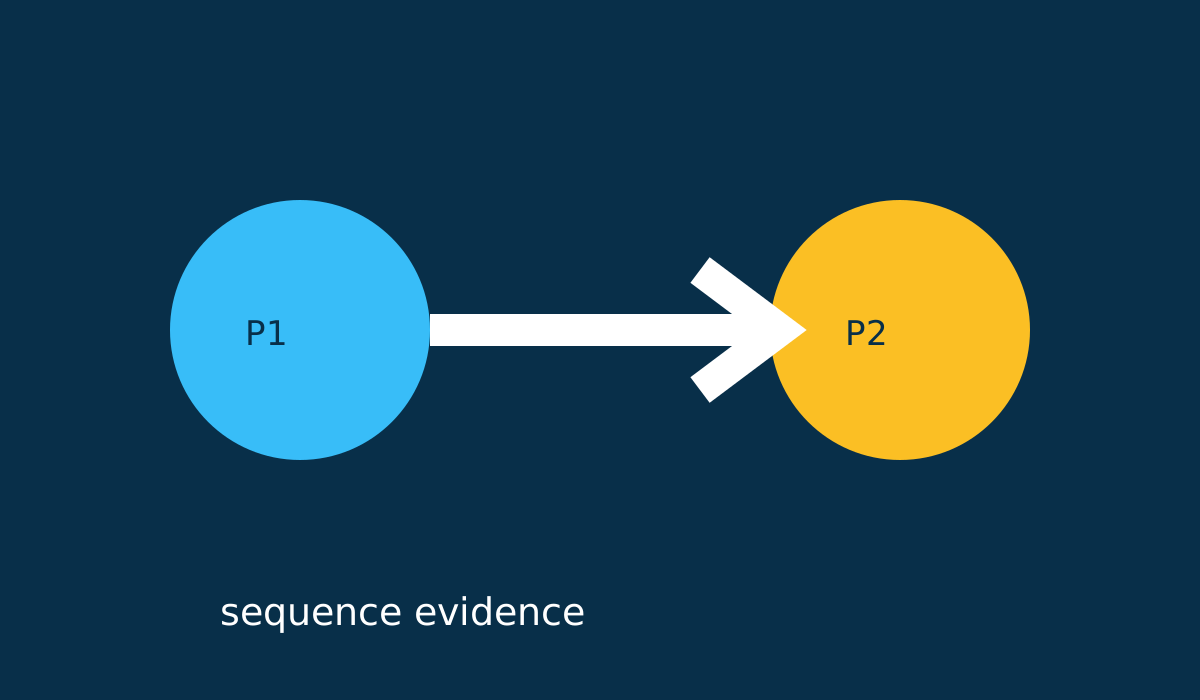
August 21, 2026. Research question: what can a billing record prove about payer order and crossover sequence before a claim is routed or reconciled?
Evidence scope and methodology: sample accounts or claims with more than one payer reference and compare the eligibility response, coordination-of-benefits field, claim submission record, primary remittance, secondary submission evidence, and account history. Define whether the unit is an encounter, claim version, or payment event before calculating any pattern. The review separates source facts, observed record conditions, calculations, and interpretation. It uses a bounded operational sample design rather than claiming a universal rate. Records without an authorized source, stable reference, or defined observation window remain unknown rather than being silently excluded.
Evidence distinction: A payer-order field or response documents what a source reported at a point in time. It does not by itself prove that another payer will accept the claim, that the patient’s benefits are fully coordinated, or that a remaining balance is collectible. This distinction matters in outsourced medical billing because a queue note can describe preparation while leaving a clinical, contractual, privacy, or financial decision with the accountable owner. The study therefore treats a timestamp, system status, payer message, and human conclusion as different evidence types.
Operational analysis: The study should separate explicit primary or secondary evidence, conflicting payer responses, missing coordination data, crossover transmitted, crossover acknowledged, and secondary adjudication. A claim’s movement through a channel is different from a payer decision. Repeated submissions for one encounter should remain linked so activity is not mistaken for independent outcomes.
What to measure: define the unit before counting. A useful review can record the source reference, service or transaction date, queue state, actor role, reviewer, next action, exception reason, and closure evidence. Record the denominator, exclusions, and observation cutoff. If a source is unavailable, report the missing evidence as a finding instead of treating the item as compliant or failed.
Philippines-based billing application: A Philippines-based specialist can assemble the payer-order chronology, compare permitted fields, identify a conflict, and route the exact question. The owner decides submission order, patient communication, balance treatment, correction, appeal, or escalation. A specialist can perform the permitted comparison, preserve the source location, prepare a factual summary, and route a precise question. This supports distributed billing work without turning administrative access into authority over coding, clinical necessity, payer interpretation, refunds, write-offs, patient communication, or final release.
Decision boundary: Do not infer secondary payment, assign responsibility, or resubmit a claim because a sequence field looks plausible. An unresolved order should remain unresolved with a named decision owner and evidence request. When the record does not answer the question, the safe result is an explicit hold with an owner, reason, and review date. A support queue should make the unresolved issue easier to decide; it should not manufacture certainty to improve an aging or completion measure.
Interpretive cautions: comparisons can change when payer mix, service mix, system configuration, definitions, or sampling changes. A higher exception count may reflect better detection. A shorter interval may reflect a different stop rule. A clean status may reflect missing documentation. Any conclusion should state the alternative explanations that the evidence cannot distinguish.
Limits: Payer rules, benefit-plan language, changing eligibility, incomplete crossover data, and account privacy constraints limit generalization. The cohort cannot determine benefit entitlement or predict payment. The public sources provide principles and definitions, not a local authorization, payment guarantee, staffing target, or legal opinion. Operationalizing a finding requires review by the appropriate billing, coding, clinical, privacy, security, finance, and legal owners.
Practical review design: start with a frozen sample containing routine items and difficult exceptions. Have an authorized second reviewer examine an overlap to identify ambiguous definitions. Keep the original observation separate from later remediation, so a corrected record does not erase the evidence gap that existed at the first review.
Evidence-led conclusion: Coordination research is strongest when it reports source-supported sequence events separately from expected financial outcomes. That separation helps outsourced billing operations prevent a plausible payer order from becoming an unsupported conclusion about the account balance.
Sources (accessed August 21, 2026): https://www.cms.gov/medicare/coordination-benefits | https://www.cms.gov/medicare/claims-processing | https://www.hhs.gov/hipaa/for-professionals/privacy/index.html
Methodology: For this coordination-of-benefits study, use an encounter, claim version, or payment event as the unit of analysis and do not combine those units in one denominator. Freeze a cohort containing single-payer records, multiple-payer records, explicit primary or secondary indicators, conflicting eligibility responses, crossover activity, and missing coordination data. For each item preserve the eligibility response wording, response date, payer identifiers, coordination field, claim control number, submission event, primary remittance, crossover transmission or acknowledgment, secondary submission, secondary adjudication, account history, and source system. Link repeated submissions to the same encounter when the source supports the relationship; otherwise report the candidate linkage and uncertainty. Separate evidence that a payer was listed from evidence that a claim was accepted, crossed over, adjudicated, or paid. Calculate sequence patterns only after defining which event counts and which records are excluded. A field that says primary is an observation at a point in time, not a promise about benefits or collection. Stratify by payer and time period because eligibility and coordination responses can change. Ask an authorized second reviewer to reproduce a sample and compare source selection, duplicate handling, and treatment of conflicting responses. Report unknowns instead of assigning a payer based on balance size, familiar order, or expected payment. The specialist may assemble the chronology and route a narrow question; the billing owner decides submission order, balance treatment, resubmission, patient communication, or appeal. Conclusion: coordination research is useful when it reports sequence evidence separately from financial expectation. A well-linked record can show what order a source reported and which crossover events occurred, but it cannot prove entitlement, responsibility, or payment without the qualified owner’s review.
Route-specific analysis for 2026-08-21: A sequencing study should treat payer order as a time-dependent observation, not a permanent property of an account. Freeze the encounter or claim version first, then capture the eligibility response date, coordination field, coverage effective period, primary transaction, remittance, crossover event, secondary submission, and secondary response. These events may disagree without any one source being defective; they answer different questions at different times. Use a lineage key that links repeated claim versions to the same encounter while keeping each submission and adjudication distinct. The evidence analysis should report explicit order statements separately from inferred order, and transmitted crossover separately from acknowledged or adjudicated crossover. A payer response that says coordination is incomplete is evidence of that response, but not proof that the account has no secondary coverage. Likewise, a primary remittance with patient responsibility does not, by itself, establish the final amount after another payer’s review. Stratify the sample by payer combination, service period, response type, and missing-data pattern. If the sample excludes claims without an identifiable secondary reference, say so because that exclusion can make sequencing appear more reliable than it is. In an outsourced medical billing operation, a specialist can preserve the chronology, identify contradictions, and prepare a neutral question such as which source governs the next routing decision. The owner decides payer responsibility, submission sequence, balance treatment, and any patient communication. Do not use a plausible order field as a reason to resubmit or transfer a balance. The evidence-led conclusion is that coordination research can measure how clearly sequence events are documented, but it cannot turn a payer-order indicator into a payment expectation or a collectible-balance conclusion. Additional route-local test for 2026-08-21: Compare the recorded order at each event boundary instead of selecting the newest field as the definitive answer. A useful observation sheet identifies the source, timestamp, payer relationship, claim version, and whether the event was reported, transmitted, acknowledged, adjudicated, or merely inferred. Treat missing crossover evidence as missing evidence, not as evidence that crossover failed. Also preserve cases where the primary payer response arrived after eligibility information changed, because timing can explain a conflict without resolving responsibility. The study can calculate the proportion of sampled items with explicit sequence support, conflicting sequence, and unresolved sequence, but those proportions describe record quality in this bounded cohort rather than benefit entitlement. This distinction is important for an outsourced billing team: the operational value is a clearer handoff and a narrower owner question, not a prediction of payment. Any account balance consequence remains subject to the applicable plan, payer response, qualified review, and authorized decision.
Route-local research methodology for coordination-of-benefits sequencing: define the unit as encounter, claim version, or payment event and freeze the cohort before counting. Include single-payer, multiple-payer, explicit primary or secondary fields, conflicting eligibility responses, crossover activity, and missing coordination data. Preserve response wording and date, payer identifiers, claim control number, submission, primary remittance, crossover transmission or acknowledgment, secondary submission, adjudication, account history, and source system. Link repeated submissions only when evidence supports the relationship. Distinguish a payer listed from a claim accepted, crossed over, adjudicated, or paid. Report source facts, calculated intervals, and owner interpretation separately. A second authorized reviewer repeats a sample. A specialist may assemble chronology and route a conflict; the owner decides order, resubmission, balance, patient communication, appeal, or escalation. Limitations include plan language, changing eligibility, payer rules, incomplete crossover records, privacy limits, and non-random sampling. The evidence cannot establish entitlement, responsibility, collectibility, or payment. Conclusion: sequencing research is useful only when order evidence is kept separate from financial expectation and unresolved records remain unresolved.
Route-local research methodology for coordination-of-benefits sequencing: define the unit as encounter, claim version, or payment event and freeze the cohort before counting. Include single-payer, multiple-payer, explicit primary or secondary fields, conflicting eligibility responses, crossover activity, and missing coordination data. Preserve response wording and date, payer identifiers, claim control number, submission, primary remittance, crossover transmission or acknowledgment, secondary submission, adjudication, account history, and source system. Link repeated submissions only when evidence supports the relationship. Distinguish a payer listed from a claim accepted, crossed over, adjudicated, or paid. Report source facts, calculated intervals, and owner interpretation separately. A second authorized reviewer repeats a sample. A specialist may assemble chronology and route a conflict; the owner decides order, resubmission, balance, patient communication, appeal, or escalation. Limitations include plan language, changing eligibility, payer rules, incomplete crossover records, privacy limits, and non-random sampling. The evidence cannot establish entitlement, responsibility, collectibility, or payment. Conclusion: sequencing research is useful only when order evidence is kept separate from financial expectation and unresolved records remain unresolved.
Route-local research methodology for coordination-of-benefits sequencing: define the unit as encounter, claim version, or payment event and freeze the cohort before counting. Include single-payer, multiple-payer, explicit primary or secondary fields, conflicting eligibility responses, crossover activity, and missing coordination data. Preserve response wording and date, payer identifiers, claim control number, submission, primary remittance, crossover transmission or acknowledgment, secondary submission, adjudication, account history, and source system. Link repeated submissions only when evidence supports the relationship. Distinguish a payer listed from a claim accepted, crossed over, adjudicated, or paid. Report source facts, calculated intervals, and owner interpretation separately. A second authorized reviewer repeats a sample. A specialist may assemble chronology and route a conflict; the owner decides order, resubmission, balance, patient communication, appeal, or escalation. Limitations include plan language, changing eligibility, payer rules, incomplete crossover records, privacy limits, and non-random sampling. The evidence cannot establish entitlement, responsibility, collectibility, or payment. Conclusion: sequencing research is useful only when order evidence is kept separate from financial expectation and unresolved records remain unresolved.
Route-local research methodology for coordination-of-benefits sequencing: define the unit as encounter, claim version, or payment event and freeze the cohort before counting. Include single-payer, multiple-payer, explicit primary or secondary fields, conflicting eligibility responses, crossover activity, and missing coordination data. Preserve response wording and date, payer identifiers, claim control number, submission, primary remittance, crossover transmission or acknowledgment, secondary submission, adjudication, account history, and source system. Link repeated submissions only when evidence supports the relationship. Distinguish a payer listed from a claim accepted, crossed over, adjudicated, or paid. Report source facts, calculated intervals, and owner interpretation separately. A second authorized reviewer repeats a sample. A specialist may assemble chronology and route a conflict; the owner decides order, resubmission, balance, patient communication, appeal, or escalation. Limitations include plan language, changing eligibility, payer rules, incomplete crossover records, privacy limits, and non-random sampling. The evidence cannot establish entitlement, responsibility, collectibility, or payment. Conclusion: sequencing research is useful only when order evidence is kept separate from financial expectation and unresolved records remain unresolved.
Route-local research methodology for coordination-of-benefits sequencing: define the unit as encounter, claim version, or payment event and freeze the cohort before counting. Include single-payer, multiple-payer, explicit primary or secondary fields, conflicting eligibility responses, crossover activity, and missing coordination data. Preserve response wording and date, payer identifiers, claim control number, submission, primary remittance, crossover transmission or acknowledgment, secondary submission, adjudication, account history, and source system. Link repeated submissions only when evidence supports the relationship. Distinguish a payer listed from a claim accepted, crossed over, adjudicated, or paid. Report source facts, calculated intervals, and owner interpretation separately. A second authorized reviewer repeats a sample. A specialist may assemble chronology and route a conflict; the owner decides order, resubmission, balance, patient communication, appeal, or escalation. Limitations include plan language, changing eligibility, payer rules, incomplete crossover records, privacy limits, and non-random sampling. The evidence cannot establish entitlement, responsibility, collectibility, or payment. Conclusion: sequencing research is useful only when order evidence is kept separate from financial expectation and unresolved records remain unresolved.
Sources: https://www.cms.gov/medicare/coordination-benefits https://www.cms.gov/medicare/claims-processing https://www.hhs.gov/hipaa/for-professionals/privacy/index.html