
Philippines staffing research
Claim Attachment Linkage Research: Can a Second Reviewer Rebuild the Chain?
A September 8 source study asking: Can two authorized reviewers independently connect the same document version to the same claim transaction and payer response?
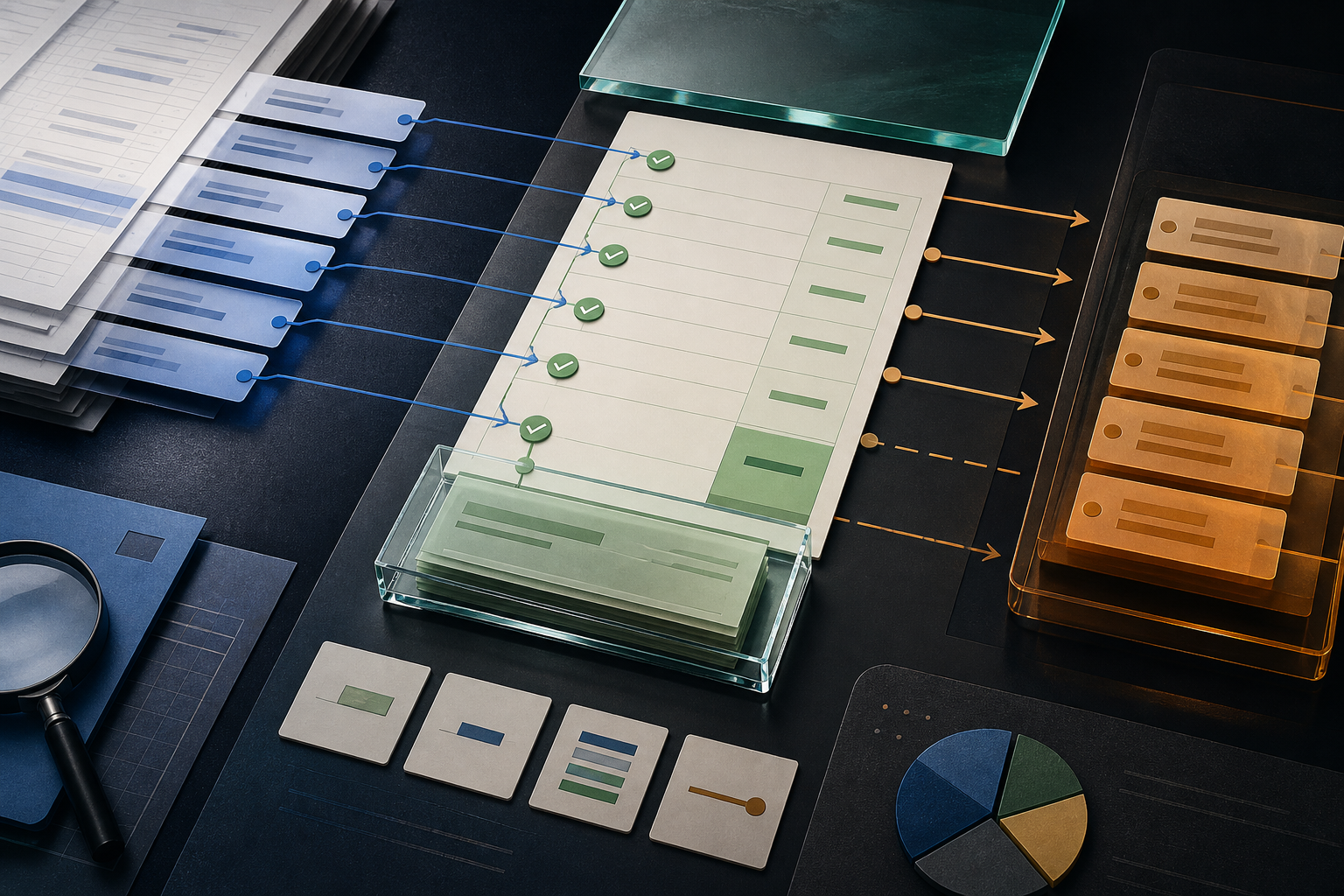
Research question: Can two authorized reviewers independently connect the same document version to the same claim transaction and payer response?
Scope: This September 8, 2026 study examines administrative evidence available to an outsourced medical billing team. Its unit of analysis is one claim-version and attachment-version pair. It does not evaluate clinical care, legal compliance, staff merit, contract entitlement, or the correctness of a final payer decision.
Methodology: Freeze the population, source report, filters, cutoff, timezone, duplicate rule, and exclusions before outcomes are reviewed. Compare attachment control numbers, transmission events, receipts, payer messages, document versions, and claim identifiers, then record the first unsupported link. Include ordinary cases, exceptions, reopened work, missing evidence, and access failures so the denominator remains visible.
Measurement: Report raw numerators and denominators with every rate. Keep event time, receipt time, system-entry time, retrieval time, and review time in separate fields. Label statements as observed, externally reported, calculated, owner-interpreted, or unknown. Study 2 never treats a queue label as the underlying source.
Reliability: Give a mixed sample to a second authorized reviewer who cannot see the first classification. Compare cohort membership, source selection, identifier linkage, date handling, calculations, and final category. Preserve disagreements and report whether consensus required a clarified rule or an owner decision.
Analysis plan: Publish source-confirmed, conflicting, missing, access-blocked, superseded, interpretation-required, and unresolved categories. Keep sequence separate from causation. An event occurring later may complete a chronology without proving why the earlier event happened.
Operational boundary: Support staff can retrieve approved records, preserve wording and chronology, reproduce arithmetic, and prepare a neutral exception. Qualified owners retain coding, coverage, medical-necessity, credentialing, contract, privacy, accounting, submission, refund, write-off, and patient-communication decisions.
Inference limits: Results describe only the frozen cohort, observation window, systems, and definitions reported here. They should not be generalized to another payer, organization, or period without replication. Association, sequence, and missing evidence do not establish causation or responsibility.
Limitations: Portal displays can change, identifiers may be transformed, and transmission evidence does not prove that a payer found the document sufficient. Non-random selection, inaccessible history, local workflows, interface changes, and unresolved records can bias the observed distribution. Unknowns remain in the denominator and later outcomes do not retroactively validate earlier documentation.
Conclusion: This design can locate a break in the evidence chain and frame the next bounded owner question. It cannot forecast acceptance, payment, appeal success, liability, or clinical correctness. That distinction is the study's central safeguard.
Source reviewed September 8, 2026: https://www.cms.gov/medicare/coding-billing/electronic-billing
Source reviewed September 8, 2026: https://www.caqh.org/core/operating-rules
Source reviewed September 8, 2026: https://www.hhs.gov/hipaa/for-professionals/privacy/index.html